
GTM Strategy: Stop Launching and Start Scaling
Most B2B SaaS companies treat a go-to-market strategy like a wedding: they spend months planning for a single day, throw a massive party, and then wonder why the spark is gone six months later. In reality, a GTM strategy is less like a wedding and more like the marriage itself; it is a continuous, evolving commitment to aligning your product with a specific market need and a repeatable distribution model. Most "strategies" we see at purple path are actually just expensive guesses dressed up in 80-slide decks that eventually die in a Google Drive graveyard.
The hard truth is that 90% of SaaS startups fail, and it is rarely because the code was bad. It is because they built a solution for a problem that nobody felt like paying to solve, or they tried to sell a $10,000 product using a $50,000 sales motion. This post will skip the "GTM 101" basics you can find on any generic blog. Instead, we are going deep into the mechanics of building a GTM engine that actually scales, focusing on the intersection of Product-Market Fit, pricing psychology, and distribution-market fit.
TL;DR: A successful B2B SaaS GTM strategy requires three non-negotiables: a hyper-specific ICP that includes an "Anti-ICP," a narrative that attacks the status quo rather than just listing features, and a distribution model that matches your Average Contract Value (ACV). Stop trying to be everything to everyone; pick a lane, price for the value you create, and build a feedback loop that turns market signals into product roadmap items.
1. The ICP and the Critical Importance of the Anti-ICP
Every founder says their product is for "enterprise companies." That is not an Ideal Customer Profile (ICP); that is a hallucination. A real ICP is defined by the specific pain points, tech stacks, and organizational triggers that make your solution a "must-have" rather than a "nice-to-have." At purple path, we often find that the most successful companies are those that know exactly who they are not for.
Defining an Anti-ICP is a superpower. If you are a high-touch, enterprise-grade security platform, your Anti-ICP might be "startups with fewer than 50 employees and no dedicated CISO." Why? Because they will churn the moment the implementation gets difficult, and they will eat up your support resources without ever providing the expansion revenue you need. By explicitly stating who you do not serve, you give your Sales and Marketing teams the permission to say "no," which protects your CAC and your sanity.
The "Jobs to be Done" Framework in GTM
Instead of focusing on demographics (company size, location), focus on the "Job to be Done." What is the specific progress your customer is trying to make? For example, a CFO doesn't buy payroll software because they like software; they buy it because they are terrified of a tax audit. Your GTM strategy should target the anxiety of the audit, not the features of the dashboard. This shift in perspective allows you to craft a narrative that resonates on an emotional level with senior leaders who have seen every feature-dump deck under the sun.
Take Intercom as an example. In their early days, they didn't just sell "chat." They sold the ability to see who your customers were and talk to them in real-time. They targeted the "job" of customer engagement, not just the "channel" of messaging. This clarity allowed them to dominate a crowded market by being the specific solution for a specific problem.
2. Narrative Design: Killing the Status Quo
In B2B SaaS, your biggest competitor isn't the other startup down the street; it is the status quo. It is the messy Excel spreadsheet, the manual process, or the "we’ve always done it this way" mentality. If your GTM narrative focuses on why you are 10% better than Competitor X, you have already lost. You need to explain why the current way of doing things is unsustainable.
A strong GTM narrative follows a specific arc:
- The Shift: Acknowledge a fundamental change in the world (e.g., "Remote work has broken traditional management hierarchies").
- The Stakes: Explain why the old way of working now leads to failure (e.g., "Using spreadsheets to track global teams leads to burnout and missed deadlines").
- The Promised Land: Describe what winning looks like in this new world.
- The Solution: Introduce your product as the vehicle to get there.
As Andy Raskin, a leader in strategic narrative, often points out, the best narratives don't start with "here is what we do." They start with "here is how the world has changed." When you position your SaaS as the only logical response to a shifting landscape, you move from being a vendor to being a partner. This is where Fractional Marketing expertise becomes invaluable, as it requires an outside perspective to see the forest through the trees and articulate that "New Way" clearly.
"The greatest challenge in GTM is not building the product, but building the category of thought in the customer's mind where your product is the only logical answer." That's the view of a Senior CRO at a Tier-1 VC-backed Tech firm.
3. Distribution-Market Fit: Matching Motion to Math
One of the most common mistakes in B2B Tech is a mismatch between the product's price and its distribution channel. You cannot have a field sales team with $150,000 salaries selling a $20-a-month seat license. Conversely, you cannot expect a purely self-serve, Product-Led Growth (PLG) motion to close a $500,000 enterprise deal that requires six months of security audits and legal reviews.
Building a GTM strategy requires a cold, hard look at your unit economics. If your ACV is under $5,000, you need a high-velocity, low-touch motion (Content, SEO, PLG). If your ACV is over $100,000, you are in the world of Account-Based Marketing (ABM) and high-touch Sales. The "Dead Zone" is in the middle, where the product is too expensive for a credit card but too cheap to justify a dedicated Sales rep.
Comparison: PLG vs. Sales-Led Growth (SLG)
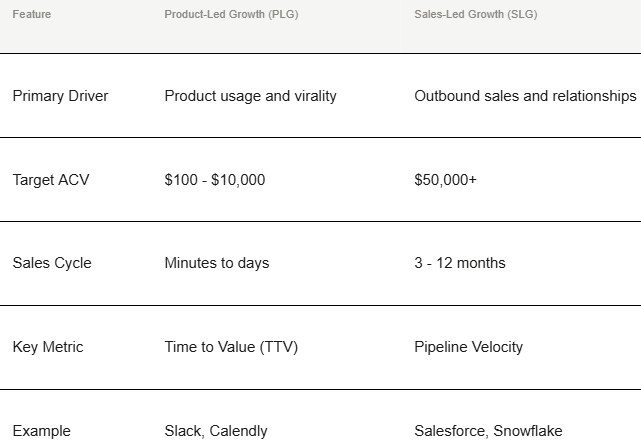
The smartest companies today are moving toward a "Product-Led Sales" model. They use a PLG motion to get their foot in the door with individual contributors, then use Sales reps to manage the enterprise-wide expansion. This hybrid approach lowers the initial CAC while maintaining the high LTV of enterprise contracts. At purple path, we help companies manage this transition by aligning their Fractional Marketing efforts with their specific sales motion, ensuring no leads are wasted in the "Dead Zone."
4. Pricing as a Strategic Lever, Not an Afterthought
Pricing is the most powerful lever in your GTM strategy, yet it is often the one that gets the least attention. Most SaaS companies default to "per-user" pricing because it is what everyone else does. But per-user pricing can actually penalize your most successful customers. If your software becomes more valuable the more people use it, why would you create a financial barrier to adding more users?
Consider usage-based pricing or value-based pricing. Snowflake disrupted the data warehousing market by charging for consumption rather than capacity. This aligned their revenue directly with the value the customer received. When building your GTM, ask: "What is the 'Value Metric' that correlates most closely with our customers' success?" Is it data processed? Messages sent? Revenue recovered? Price based on that, and your GTM will feel like a partnership rather than a tax.
Your pricing strategy also has to account for the "Psychology of the Contract." In the enterprise world, a $49,000 contract often requires less scrutiny than a $51,000 contract because of internal procurement thresholds. A savvy GTM leader knows these nuances and builds them into the pricing tiers to accelerate deal velocity.
5. The Feedback Loop: Measuring What Matters
A GTM strategy is a hypothesis that needs to be tested. If you aren't measuring the right things, you are just flying blind. Most people look at lagging indicators like Revenue or Churn. While important, these don't help you adjust your strategy in real-time. You need leading indicators.
Key leading indicators for a B2B SaaS GTM include:
- Activation Rate: The percentage of new users who reach the "Aha! moment" within the first 24 hours.
- Sales Velocity: How quickly a lead moves through your pipeline. If this is slowing down, your narrative might be losing its edge.
- CAC Payback Period: How many months it takes to earn back the cost of acquiring a customer. For SaaS, anything under 12 months is excellent; over 18 months is a red flag.
- Expansion Revenue: Are your existing customers buying more? This is the ultimate proof of Product-Market Fit.
At purple path, we emphasize the importance of "Marketing-Sourced Pipeline" as a shared metric between Marketing and Sales. When both teams are incentivized by the same outcome, the friction that typically plagues GTM execution disappears. This is why Fractional Marketing is so effective; it brings an objective, data-driven perspective to the table that isn't bogged down by internal politics.
6. Content as a Moat: Moving Beyond SEO
In a world of AI-generated fluff, "content marketing" has become a dirty word. But true thought leadership is still a massive competitive advantage. Your GTM strategy should include a plan for "Zero-Click Content," meaning content that provides value directly on the platform where it is consumed (LinkedIn, Twitter, Newsletters) without requiring a click-through to your website.
Senior leaders don't have time to read 3,000-word SEO pillars. They want sharp, contrarian insights that challenge their thinking. Your content should prove that you understand their problems better than they do. As Gartner research shows, B2B buyers spend only 17% of their total buying journey meeting with potential suppliers. The rest of the time, they are doing independent research. Your content is your "silent salesperson" during that other 83% of the time.
"Content is not a lead generation tool; it is a trust-building engine. If you aren't willing to give away your best ideas for free, you aren't ready to compete in B2B SaaS." That's the take from purple path's VP of Marketing.
Conclusion: The Strategy is Never "Done"
Building a go-to-market strategy for a B2B SaaS company is not a project you finish; it is a discipline you practice. It requires a relentless focus on the ICP, a narrative that challenges the status quo, and a distribution model that respects the math of your business. Most importantly, it requires the humility to listen to the market and pivot when the data tells you that your hypothesis was wrong.
The companies that win are those that bridge the gap between "what we built" and "why it matters." They don't just launch products; they start movements. They don't just hire agencies; they find partners who can act as a fractional extension of their leadership team to provide the strategic clarity and execution muscle needed to scale.
Key Takeaways:
- Define your Anti-ICP to protect your margins and focus your team.
- Build a narrative that attacks the status quo, not just your competitors.
- Ensure your distribution motion (PLG vs. SLG) matches your ACV.
- Price based on a value metric that aligns your success with your customer's success.
- Measure leading indicators like Activation Rate and Sales Velocity to stay agile.
If your GTM strategy feels like a collection of random acts of marketing, it is time to bring in the experts. At purple path, we provide the Fractional Marketing leadership that B2B Tech companies need to turn a messy launch into a scalable growth engine. We don't do fluff, and we don't do 80-slide decks that go nowhere. We do strategy that executes.
Ready to sharpen your path to market? Let’s talk.
Frequently Asked Questions
How long does it take to build a GTM strategy?
A foundational GTM strategy can be built in 4 to 6 weeks, but it should be treated as a living document. The initial phase involves deep-dive interviews with customers, market analysis, and narrative development. However, the refinement of that strategy based on real-world feedback is an ongoing process that never truly ends.
What is the difference between a Marketing Plan and a GTM Strategy?
A Marketing Plan is a tactical roadmap for how you will promote a product (channels, budgets, timelines). A GTM Strategy is a broader, cross-functional framework that encompasses product-market fit, pricing, sales motions, and the overarching narrative. Marketing is a subset of GTM.
When should a SaaS company hire Fractional Marketing help for GTM?
Fractional Marketing is ideal when a company is in the "Scale-Up" phase (typically between Seed and Series B), where they need senior-level strategic guidance but aren't ready for the $300k+ overhead of a full-time CMO. It is also useful for established companies launching a new product line that requires a fresh, objective perspective.
Should we focus on PLG or Sales-Led first?
This depends entirely on your product complexity and target buyer. If your product provides immediate value to an individual user without needing IT approval, start with PLG. If your product requires complex integration or changes how an entire department works, start with a Sales-Led motion to ensure successful implementation and adoption.
What is the most common reason GTM strategies fail?
Lack of alignment between Sales, Marketing, and Product. If Marketing is generating leads that Sales can't close, or if Sales is promising features that Product hasn't built, the GTM engine will stall. A successful GTM requires a "Single Source of Truth" for the ICP and the narrative across all three departments.