The Fractional Head of Content: Driving Attention in B2B SaaS (2026 Guide)
In B2B SaaS in 2026, growth isn't just about having a great product; it's about winning the battle for attention and trust. Founders and CEOs often find themselves stuck with a content strategy that feels more like a random collection of blog posts than a predictable pipeline driver. The result is a stalled growth curve, wasted marketing spend, and a brand voice that fails to resonate in a crowded market.
This guide explores a strategic solution: the Fractional Head of Content. Discover how this flexible leadership model can build a sophisticated content engine that drives authority, generates qualified leads, and aligns with your GTM strategy—all without the financial commitment and long-term risk of a full-time executive hire.
Key Takeaways
- Strategic vs. Tactical: A Fractional Head of Content is a strategic leader who builds and manages your entire content ecosystem, unlike a freelance writer who executes specific tasks. Their primary goal is to turn content into a measurable revenue-driver.
- The Content Engine Framework: A high-performance content strategy is built on five pillars: Audience & ICP Deep Dive, GTM & Narrative Alignment, Content Production & Operations, Multi-channel Distribution, and Performance Analytics.
- Cost-Effective Expertise: The fractional model provides access to tier-one strategic talent—leaders who have scaled content at other successful SaaS companies—at a fraction of the cost and risk associated with a full-time executive hire.
- Global Nuance is Key: Effective content strategy requires localization. An expert can adapt messaging and distribution for different markets, such as the trust-focused landscape in Europe versus the high-velocity tech scene of the US East Coast.
Table of Contents
- What is a Fractional Head of Content and Why Does Your SaaS Need One?
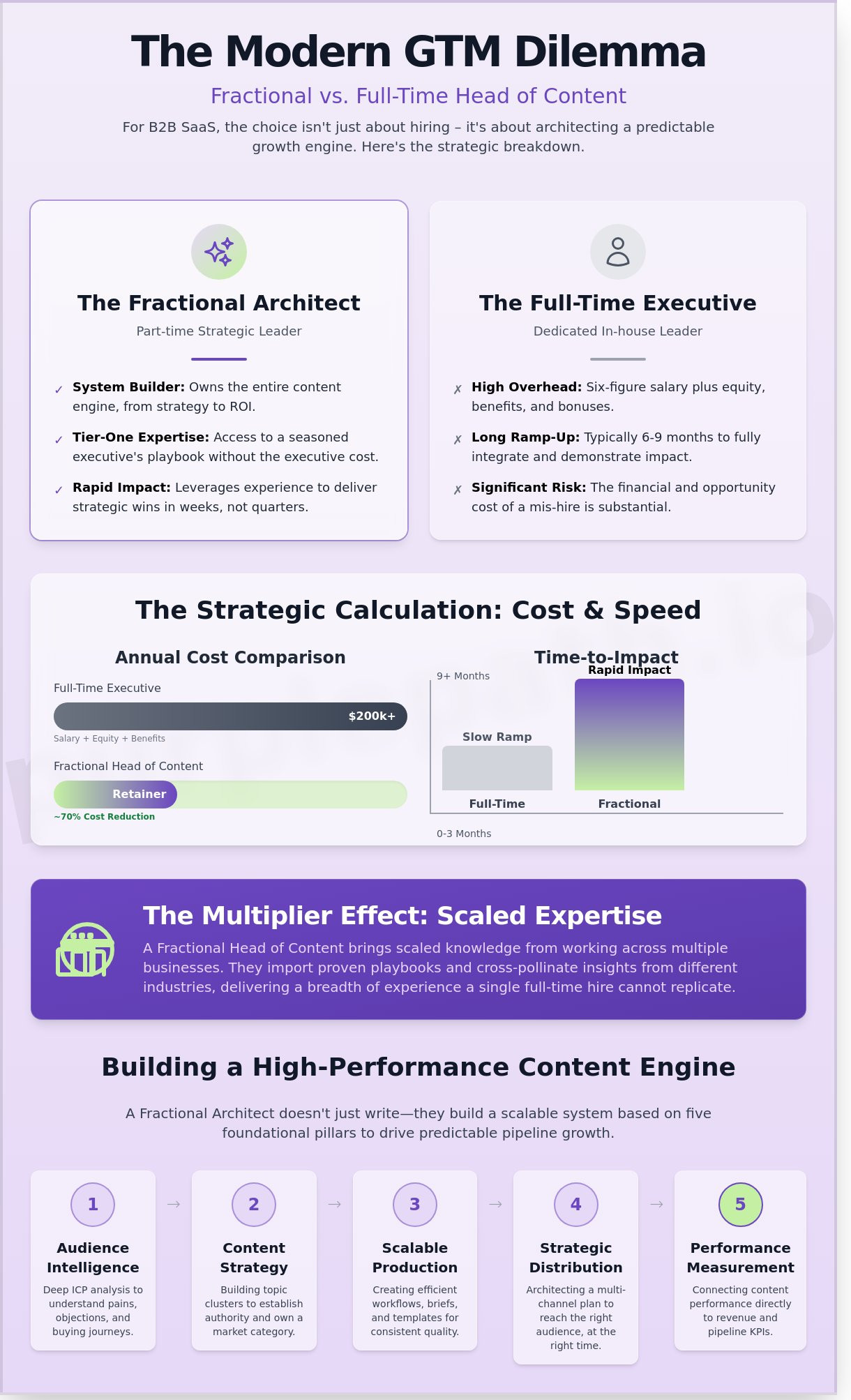
- The 5 Pillars of a High-Performance Content Engine
- Fractional Head of Content vs. Full-Time Executive: A Strategic Comparison
- Navigating Regional GTM Challenges: From Dublin to New York
- Implementing the purple path: How to Start Your Content Transformation
- Frequently Asked Questions
What is a Fractional Head of Content and Why Does Your SaaS Need One?
A Fractional Head of Content is a part-time, senior-level strategist who owns the entire content lifecycle for your B2B SaaS company. They are not just a writer or an editor; they are the architect of your content engine, responsible for strategy, planning, execution management, and performance measurement. Their role is to transform content from a cost center into a predictable source of pipeline and authority.
Unlike a traditional VP of Marketing who oversees multiple functions, a Fractional Head of Content has a singular focus: building a system that consistently produces high-value content that attracts, engages, and converts your ideal customer profile (ICP). They close the "Content Gap"—the all-too-common space where random acts of content creation fail to connect with a cohesive GTM strategy, leaking potential revenue and brand equity.
According to Chief Revenue Officer (CRO), this is a well-documented area of ongoing research and practical application.
In tech hubs from Dublin to Vienna, forward-thinking SaaS companies are adopting this model in 2026 to inject C-suite level expertise into their marketing function without the associated burn rate, ensuring their message cuts through the noise and drives meaningful business outcomes.
Fractional Head of Content vs. Freelance Writer: The Key Differences
Understanding the distinction between a strategic leader and a tactical executor is crucial. While both are valuable, they solve fundamentally different problems.
- Strategy vs. Execution: A freelance writer executes a brief; a Fractional Head of Content creates the entire strategy that generates the brief. They own the "why" behind every piece of content.
- Ownership of Outcome: A Fractional Head of Content owns the outcome (pipeline influence, lead generation, authority), while a freelancer owns the deliverable (the article, the whitepaper).
- System Building: A fractional leader builds scalable systems—editorial calendars, style guides, distribution playbooks, and analytics dashboards. This is a long-term strategic partnership, like the one offered by purple path GTM execution services, designed to build a lasting asset for your company.
The 'Content Architect' Mindset
A true Head of Content views your audience's journey not as a linear funnel but as a continuous loop of education, validation, and trust-building. They understand the technical precision required in modern content marketing, from SEO and keyword strategy to aligning assets with specific sales cycle stages.
Ultimately, a Fractional Head of Content's primary goal is to synchronize your brand narrative, product marketing, and demand generation efforts into one high-velocity engine that establishes your company as the definitive authority in its category.
The 5 Pillars of a High-Performance Content Engine
To move from sporadic blog posts to a predictable growth driver, a Fractional Head of Content immediately audits and optimises five foundational pillars. This framework uses data as the source of truth to guide every strategic decision, ensuring that content creation is purposeful and directly tied to business objectives. Addressing these areas is critical for overcoming the early common marketing strategy challenges that stall SaaS growth.
Pillar 1: Audience & ICP Deep Dive
You cannot create resonant content without a profound understanding of who you're talking to. This pillar goes beyond basic demographics to uncover the deep-seated pains, motivations, and daily workflows of your ideal customer. It involves customer interviews, sales team feedback, and data analysis to build a living, breathing picture of the audience, ensuring every piece of content speaks their language.
Research published by challenges in go-to-market execution shows that this is a well-documented area of ongoing research and practical application.
Pillar 2: GTM & Narrative Alignment
Content doesn't exist in a vacuum. This pillar ensures the content strategy is inextricably linked to the company's overarching Go-to-Market strategy. A Fractional Head of Content works with leadership to define a core narrative, establish key messaging pillars, and map content topics to every stage of the buyer's journey, from top-of-funnel awareness to bottom-of-funnel decision-making.
Pillar 3 & 4: Production Operations and Multi-Channel Distribution
Great ideas are meaningless without a system for execution and amplification. This involves building a robust production workflow, including an editorial calendar, content briefs, style guides, and a network of writers or creators. Simultaneously, it means designing a distribution strategy that gets the right content in front of the right audience on the right channels—be it through organic search (SEO), social media, email newsletters, or strategic partnerships.
Pillar 5: Performance & Analytics
The final pillar closes the loop by tying content efforts to tangible business results. A Fractional Head of Content establishes a clear analytics framework to measure what matters: organic traffic, keyword rankings, lead generation, content-influenced pipeline, and ultimately, revenue. This data-driven approach allows for continuous optimization, doubling down on what works and eliminating what doesn't.
Fractional Head of Content vs. Full-Time Hire: A Strategic Comparison
For a Seed to Series B startup, the decision to hire a senior leader is one of the most critical—and costly—they can make. Here we address the number one question: why choose a part-time leader over a dedicated full-time executive for your content function?
The analysis comes down to a blend of financial pragmatism, speed to impact, and access to a breadth of expertise that is often out of reach for an early-stage company.
The Cost of a Mis-Hire in B2B SaaS
Industry data suggests a failed senior hire can cost a company up to 3x their annual salary in lost time, recruitment fees, and stalled momentum. For a startup in a competitive market like London or NYC, a year of ineffective content strategy isn't just a setback; it can be fatal. The fractional model mitigates this risk. It offers the flexibility to access senior-level strategy and scale the engagement up or down based on evolving business needs, often for a transparent, flat monthly retainer. You can see reach out to learn more about a value-based approach at purple path.
Access to Tier-1 Expertise and Speed to Impact
The fractional model democratizes expertise. It allows a Seed-stage company to bring in a leader who has already built and scaled content engines to $50M+ ARR. This individual doesn't need a six-month onboarding period; they arrive with proven playbooks, frameworks, and a network of talent, ready to make an impact from day one. Furthermore, because fractional leaders often work with a small portfolio of non-competing clients, they bring the benefit of "cross-pollination"—applying insights and successful tactics from multiple B2B markets to solve your unique challenges.
Tailoring Content Strategy: From Dublin to New York
A one-size-fits-all content strategy is doomed to fail in a global B2B SaaS market. The cultural, regulatory, and competitive landscapes vary dramatically between regions, demanding a nuanced approach. A seasoned Fractional Head of Content understands how to adapt the GTM messaging for maximum resonance, whether they're targeting enterprise buyers in Central Europe or fast-moving startups on the US East Coast. As a partner with deep roots in both Ireland and Austria, purple path is uniquely positioned to bridge these gaps.
The European SaaS Landscape: Trust and Compliance
Building a pipeline in Europe is a game of trust and authority. Content strategy must be built around GDPR compliance, often favoring ungated thought leadership and relationship-building over aggressive, US-style lead capture forms. Winning enterprise deals in the DACH (Germany, Austria, Switzerland) and Benelux regions requires localized content that demonstrates a deep understanding of market-specific challenges and longer, more consensus-driven sales cycles.
Conquering the East Coast US Market
In the high-velocity tech scenes of New York and Boston, the approach shifts. The messaging must be direct, data-driven, and focused on clear ROI. The competitive density is higher, making a strong, differentiated brand voice essential. Here, Account-Based Marketing (ABM) content plays a much larger role, with personalized assets designed to penetrate key enterprise accounts. An effective content leader knows how to build and manage a strategy that speaks to this pace and intensity.
Implementing the purple path: How to Start Your Content Transformation
Engaging a Fractional Head of Content is the first step on a collaborative journey to transform your content function from a nice-to-have into a must-have growth engine. The process is designed to deliver value quickly, focusing on building a sustainable system for long-term success. The first 90 days are critical for laying this foundation.
Ready to Fix Your Stalled Pipeline?
Sustainable growth is a path, not a destination. It requires a strategic guide who can architect a content engine that consistently delivers value to your audience and your bottom line. If your content isn't producing the results you need, it's time to move beyond random acts of creation and embrace a strategic, system-level approach.
Contact the experts at purple path to begin your GTM and content audit today.
Frequently Asked Questions (FAQ)
What is the typical cost of a Fractional Head of Content in 2026?
Costs vary based on scope and the leader's experience, but typically range from €4,000 to €12,000 per month on a retainer basis, which is significantly less than the fully-loaded cost of a full-time executive.
How many hours a week does a Fractional Head of Content typically work?
Engagements usually range from 10 to 20 hours per week. The focus is on strategic impact and system-building, not just hours logged, allowing for high efficiency.
Can a Fractional Head of Content manage an existing team of writers?
Yes, absolutely. A key function of the role is to lead and mentor your existing content team (in-house or freelance), improving their output and aligning their work with the new strategy.
Is a Fractional Head of Content the same as a Fractional CMO?
No. A Fractional CMO owns the entire marketing function, including demand gen, brand, and product marketing. A Fractional Head of Content specializes specifically in building and scaling the content engine, often working under a Fractional CMO or CEO.
When is the right time for a SaaS startup to hire a Fractional Head of Content?
The ideal time is when you have product-market fit but your content efforts feel chaotic, are not generating leads, or lack a clear strategic direction. This is typically in the Seed to Series B stage.
How do you measure the success of a Fractional Head of Content engagement?
Success is measured against pre-defined business goals. Key metrics often include growth in organic traffic and keyword rankings, an increase in marketing-qualified leads (MQLs) from content, improved lead-to-close conversion rates, and lower Customer Acquisition Cost (CAC).