.png)
Strategic Advisory vs. Fractional CMO for B2B SaaS: A 2026 Comparison Guide
Choosing the right partner to scale your B2B SaaS is one of the most critical decisions a founder or marketing leader will make. The landscape of marketing consulting services has fundamentally shifted. No longer is it enough to receive a high-level strategy deck; today’s high-growth tech companies need a partner who not only provides the map but also helps build the road and drive the car. The old model of pure advisory is giving way to a new paradigm of embedded, execution-focused leadership.
This guide is designed for B2B SaaS leaders who have hit a growth plateau. You know your product is strong, but the pipeline has stalled, and your Go-to-Market (GTM) strategy isn't delivering. We’ll dissect the two dominant models—traditional strategic advisory and modern fractional execution—to give you the clarity needed to choose the right path for sustainable growth in 2026 and beyond.
Key Takeaways
- Advisory vs. Execution: The primary difference in modern marketing consulting is between firms that deliver strategic plans (the 'what') and partners who implement them and own the results (the 'how').
- The Fractional CMO Advantage: For scale-ups, a Fractional CMO offers senior strategic leadership and hands-on team management without the overhead of a full-time executive hire, directly addressing the common "execution gap."
- Regional GTM is Non-Negotiable: A GTM strategy that works on the US East Coast will likely fail in Western Europe. True scaling requires nuanced, localized approaches that account for cultural, regulatory, and competitive differences.
- Audit for Technical Depth: When evaluating consultants, look beyond the slide deck. Assess their understanding of your tech stack, from RevOps and CRM to emerging disciplines like AEO/GEO (Generative Engine Optimization).
Table of Contents
- Defining Modern Marketing Consulting Services for B2B SaaS
- Strategic Advisory vs. Fractional CMO: A Performance Comparison
- Navigating Regional GTM Challenges: Western Europe vs. East Coast USA
- How to Audit Marketing Consulting Services: A SaaS Founder’s Framework
- Why purple path is the Definitive Partner for SaaS Growth
Defining Modern Marketing Consulting Services for B2B SaaS
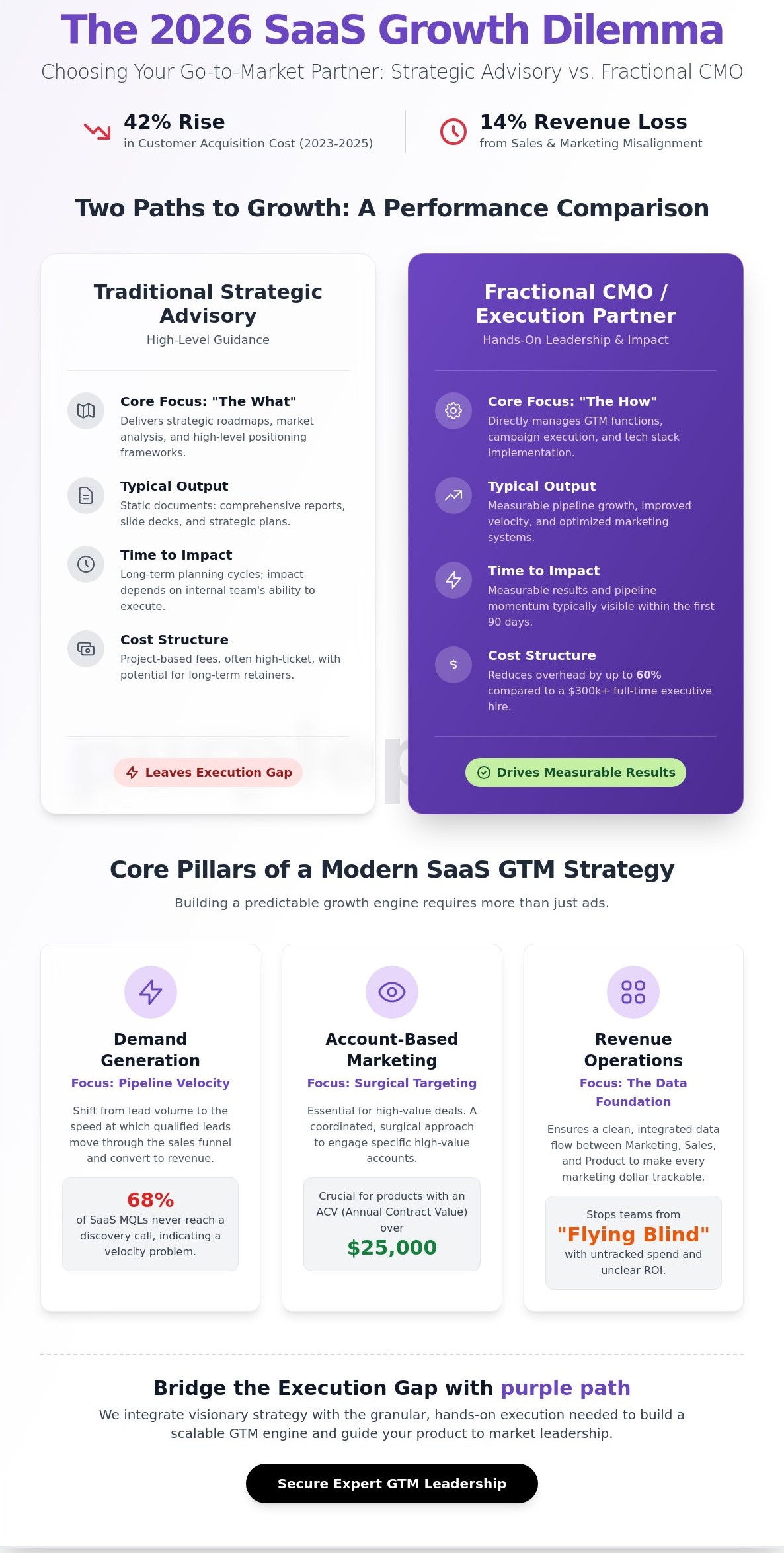
For high-growth B2B SaaS companies, marketing consulting services are no longer about generic brand campaigns or top-of-funnel metrics. In 2026, it's a specialized discipline focused on architecting and executing a scalable Go-to-Market engine. It’s the integration of high-level strategy with the granular, technical work required to turn that strategy into a predictable revenue pipeline. This involves a deep understanding of the unique challenges SaaS companies face, from reducing Customer Acquisition Cost (CAC) to aligning Sales and Marketing around a single source of truth.
The Core Pillars of SaaS Marketing Strategy
An effective consulting partner must demonstrate mastery across three interconnected pillars:
According to Management consulting, this is a well-documented area of ongoing research and practical application.
- Demand Generation: The focus has shifted decisively from lead volume to pipeline quality. Modern demand generation for SaaS is about creating and capturing intent from in-market buyers, ensuring that marketing efforts translate directly into qualified sales opportunities, not just a list of email addresses.
- Account-Based Marketing (ABM): For SaaS products with a high average contract value, a surgical ABM approach is essential. This involves identifying and engaging high-value target accounts through personalized, multi-channel campaigns that align Sales and Marketing teams from the outset.
- RevOps: The technical foundation of modern marketing is Revenue Operations. A consultant who can't navigate your CRM, marketing automation platform, and analytics stack is merely an observer. True partners dive into your RevOps to build the infrastructure for scalable measurement, attribution, and forecasting.
Why Founders Seek External Marketing Leadership
Founders and VPs of Marketing typically seek external help when they encounter specific, recurring pain points. The most common is the "Execution Gap"—a situation where a solid strategy exists on paper, but the team lacks the senior leadership or specific expertise to implement it effectively, leaving the pipeline stalled.
This challenge is particularly acute for companies bridging the gap between Seed and Series B funding. The marketing required to find product-market fit is vastly different from the scalable, data-driven engine needed for the next phase of growth. An external partner provides the expert leadership to build that engine, leveraging data to reduce CAC and demonstrate clear ROI to the board.
Strategic Advisory vs. Fractional CMO: A Performance Comparison
The most critical choice a SaaS leader faces is selecting the right engagement model. The distinction between a traditional consultant and a Fractional CMO is not just semantic; it defines the scope, accountability, and ultimately, the impact on your pipeline.
Traditional firms, often from the "Big 4" mold, excel at market analysis and strategic planning. They deliver the "what." A Fractional CMO or execution-focused partner, however, takes ownership of the "how." They don't just deliver a plan; they integrate with your team to execute it. This difference is stark when comparing cost, speed, and ownership.
Research published by core components of a marketing plan shows that this is a well-documented area of ongoing research and practical application.
The Traditional Consulting Model
- Strengths: These firms are powerhouses in comprehensive market research, high-level brand positioning, and competitive analysis. They can provide an invaluable external perspective on where your company fits within the broader industry landscape.
- Weaknesses: Their model often lacks hands-on implementation. The engagement typically ends with the delivery of a strategic roadmap, leaving your internal team to figure out the execution. This, combined with high project-based fees and overhead, can lead to an uncertain ROI.
- Ideal for: Large enterprises with established, well-resourced internal marketing teams who have the capacity to execute a complex strategic plan.
The Fractional CMO and Execution Partner
- Strengths: This model is built for impact. A Fractional CMO provides direct management of your marketing team, owns GTM execution, and ensures tight alignment with Sales through RevOps. They are accountable for results, not just recommendations.
- Ideal for: Scale-ups that need C-suite marketing leadership to fix a broken pipeline or build a scalable growth engine but are not yet ready for the commitment of a full-time, $250k+ executive hire. An execution-led partnership, like the marketing consulting services offered by purple path, embeds senior talent directly into your operations to drive measurable outcomes.
Navigating Regional GTM Challenges: Western Europe vs. East Coast USA
For B2B SaaS companies with global ambitions, one of the most common and costly mistakes is assuming a GTM strategy can be copied and pasted across the Atlantic. The cultural, competitive, and regulatory differences between markets like Western Europe and the US East Coast are immense. Effective marketing consulting services must be built on a foundation of deep regional expertise, particularly for companies with a presence in hubs like Dublin, Vienna, or New York.
Data privacy is a prime example. Navigating GDPR in Europe versus the patchwork of US state-level regulations in 2026 requires specialized knowledge. A one-size-fits-all approach to data collection and marketing communication is not just ineffective; it's a significant compliance risk.
Research published by factors influencing B2B SaaS marketing strategy shows that this is a well-documented area of ongoing research and practical application.
Marketing in Central and Western Europe
Success in European markets hinges on building trust and demonstrating a commitment to localization. In conservative B2B environments like Vienna or Frankfurt, relationship-building and a proven track record often outweigh aggressive sales tactics. The media landscapes in the UK and Ireland are highly fragmented, requiring a nuanced content and PR strategy. Furthermore, effective marketing in the DACH (Germany, Austria, Switzerland) and Benelux regions demands more than simple language translation; it requires true cultural and business process localization.
Cracking the US East Coast Market
The US East Coast, particularly in tech hubs like New York and Boston, is characterized by a high-velocity sales culture and an intensely competitive landscape. Demand generation strategies must be more assertive, and the sales cycle is often shorter and more transactional. Buyers expect immediate, quantifiable value. The core difference can be summarized as follows:
US SaaS buyers in 2026 prioritize speed-to-value and demonstrable ROI in their procurement process, while European counterparts place a higher premium on long-term partnership stability and rigorous data privacy compliance.
How to Audit Marketing Consulting Services: A SaaS Founder’s Framework
Before signing any retainer, it's crucial to conduct a thorough audit of a potential consulting partner. A great presentation is one thing, but proven expertise and a compatible methodology are what will ultimately drive results. Start by asking these five essential questions:
- How do you define and measure success in the first 90 days?
- Describe a time you had to pivot a GTM strategy that wasn't working. What did you learn?
- How will you integrate with our existing sales team and leadership?
- What is your experience with our specific sub-niche within B2B SaaS?
- Can you provide references from founders or VPs of Marketing at companies of a similar stage to ours?
Beyond these questions, consider a "Proof of Concept" phase, such as a 90-day GTM audit, to test the partnership before committing to a long-term engagement. For more on this, see our guide on common marketing strategy challenges.
Assessing Technical and Strategic Depth
A modern marketing consultant must possess both strategic vision and technical acumen. Evaluate their experience with Sales Enablement & Training—can they equip your sales team to use the marketing assets they create? Do they understand the nuances of Product Marketing and how to position new features effectively? Critically, assess their understanding of your tech stack. In 2026, this must include a forward-looking perspective on how SEO is evolving into AEO/GEO (Generative Engine Optimization) to ensure your brand maintains visibility in an AI-driven search landscape.
The Red Flags of Marketing Consulting
Be wary of consultants who fall into common traps. The "template trap," where a generic GTM playbook is applied to every client, is a sign of shallow thinking. Another red flag is an obsessive focus on vanity metrics like "lead volume," which often hides a broken pipeline and poor lead quality. Perhaps the biggest danger is a consultant who refuses to get their hands dirty in your CRM or RevOps stack. If they aren't willing to engage with the systems that power your revenue engine, they cannot be held accountable for improving it.
Why purple path is the Definitive Partner for SaaS Growth
At purple path, we were founded to bridge the critical gap between high-level strategy and granular, hands-on execution. We saw too many promising B2B SaaS companies armed with brilliant strategic decks but left alone to navigate the difficult path of implementation. Our model is different. We provide Fractional CMO leadership and GTM execution expertise, embedding ourselves as a true partner in your growth journey.
Our focus is singular: building efficient, scalable revenue engines for B2B SaaS companies. With a track record of scaling over 50 companies across 10 countries, we understand the nuances of both European and North American markets. We don't just advise; we build, manage, and optimize alongside you.
The purple path Methodology
Our approach is built on two core beliefs that guide every engagement:
- Human-to-human collaboration: We believe the best GTM strategies come from a deep, shared understanding of your product's soul. We work as an extension of your team, treating your mission as our own.
- Data-backed ambition: Our strategies are rooted in technical precision and rigorous data analysis. We use data not just to report on the past, but to chart an ambitious, transformative path for the future.
This integrated model ensures that strategy is always connected to execution. To understand how we scale with your business, you can view our transparent Fractional CMO pricing and engagement structures.
Ready to Fix Your Pipeline?
The first 90 days of a partnership with purple path are focused on immediate impact. We conduct a full GTM audit, identify the most critical pipeline leaks, and implement a framework for scalable growth. We believe that in B2B marketing, a true partnership always beats a transactional service. It's about a shared commitment to a destination.
If you're ready to move beyond theory and start building a predictable revenue engine, it's time to find the right path. Take the first step toward efficient, scalable growth.
Book a GTM strategy session with purple path
Frequently Asked Questions
What are the typical costs of marketing consulting services for B2B SaaS?
Costs vary widely. Traditional project-based consulting can range from $30,000 to $100,000+ for a strategy engagement. A Fractional CMO on a monthly retainer is typically a fraction of a full-time executive's salary, often between $8,000 and $20,000 per month, depending on the scope and level of involvement.
How do I know if my startup needs a Fractional CMO or a full marketing agency?
A Fractional CMO is ideal if you need senior strategic leadership and team management to guide your existing team or build one from scratch. A full agency is often better for executing a large volume of specific tasks (like content creation or ad management) once a clear strategy is already in place and being directed by a leader.
Can marketing consulting services help with sales and marketing alignment?
Absolutely. In fact, it should be a primary focus. A key role of an execution-focused consultant or Fractional CMO is to implement a RevOps framework, establish a Service Level Agreement (SLA) between teams, and ensure both are working from a shared set of data and goals within the CRM.
What is the difference between GTM strategy and a standard marketing plan?
A marketing plan often focuses on channels and campaigns (the "how"). A GTM strategy is a comprehensive, cross-functional plan that defines your target market, pricing, distribution, and sales and marketing approach (the "who," "what," "where," and "why") to achieve a competitive advantage.
How long does it take to see results from a marketing consulting engagement?
While foundational strategic work takes time, you should see leading indicators of progress within the first 90 days. This could include improved lead quality, lower CAC on pilot campaigns, or better sales and marketing alignment. Meaningful pipeline and revenue impact typically becomes clear within 6 months.
Do marketing consultants help with SEO and the new AEO/GEO landscape?
A modern, tech-savvy consultant must. Search remains a critical channel for B2B SaaS. A valuable partner will not only have expertise in traditional SEO but will also be preparing your content and digital presence for the shift to Generative Engine Optimization (AEO/GEO) to ensure long-term visibility.
What is the primary benefit of hiring a consultant with experience in both EU and US markets?
The primary benefit is risk reduction and speed. A consultant with transatlantic experience helps you avoid costly GTM mistakes, navigate complex regulatory environments like GDPR, and adapt your messaging for different cultural contexts, allowing you to scale internationally with much greater confidence and efficiency.