Sales Enablement Training: The Strategic Blueprint for B2B SaaS Growth in 2026
Implementing a modernized approach to sales enablement training is the only way to reclaim the limited window of influence and drive meaningful engagement. At purple path, we understand the friction of watching talented new hires face six month ramp-up times while high-value leads stall in the pipeline due to fragmented messaging.
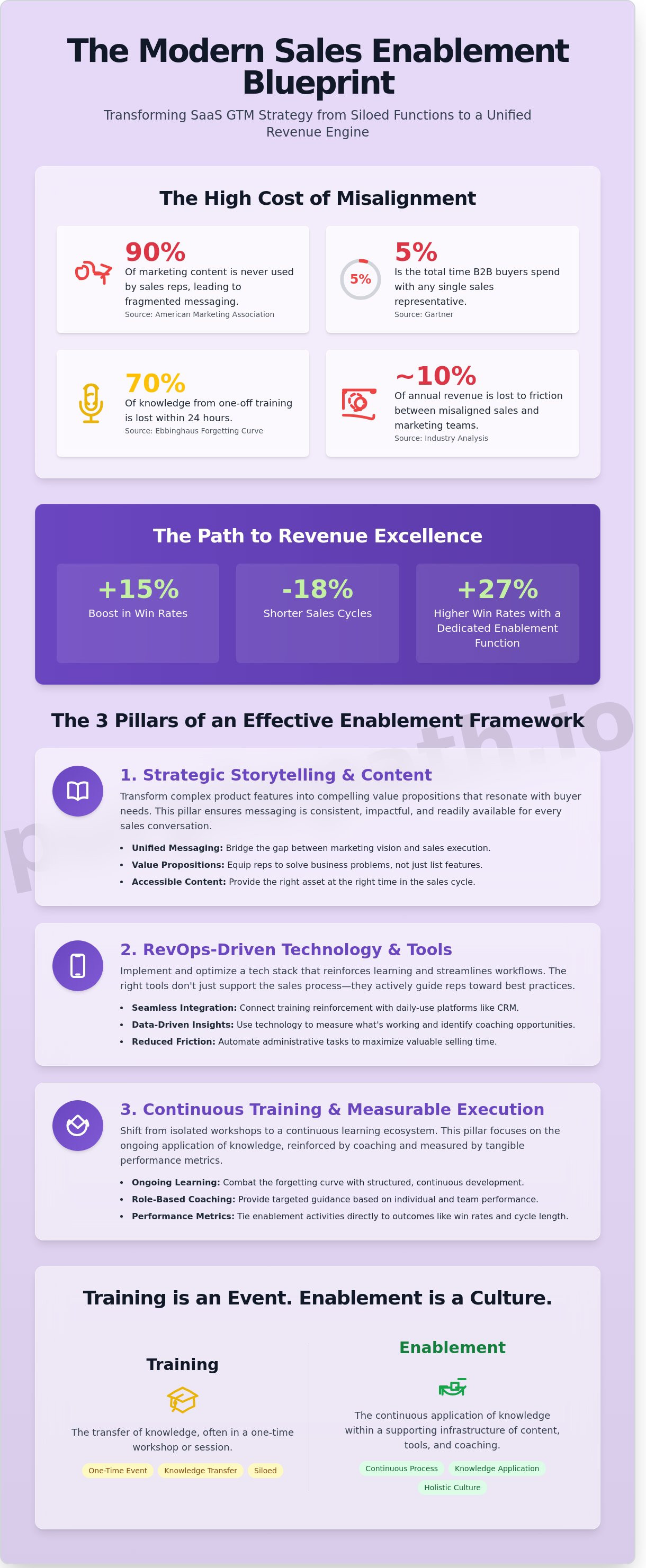
We agree that the traditional siloed approach to growth is failing the modern SaaS enterprise. You need a system that translates complex product features into compelling value propositions without the usual friction. This article promises to show you how to transform your sales team from a group of individual contributors into a unified revenue engine through data-backed strategies. We've seen these impactful methods shorten sales cycles by 18% and boost win rates by 15% for our customers. We're outlining the clear path toward seamless GTM alignment and the scalable onboarding processes required to dominate the market by 2026.
Key Takeaways
- Move beyond isolated workshops by shifting toward a holistic culture where content, tools, and training converge into a unified revenue engine.
- Combat the Ebbinghaus Forgetting Curve—where 70% of knowledge is lost within 24 hours—by replacing generic sessions with a structured, continuous learning ecosystem.
- Architect a scalable sales enablement training framework built on the three pillars of strategic storytelling, RevOps-driven technology, and measurable execution.
- Navigate the complexities of international B2B scaling by adapting your GTM strategy to bridge the cultural gap between DACH and Anglo-Saxon business landscapes.
- Discover how fractional leadership through purple path provides the strategic oversight needed to transform high-level GTM vision into granular, high-impact results.
Table of Contents:
- What is Sales Enablement Training and Why Does SaaS Need It?
- Building the Framework: Core Pillars of Modern Enablement
- AI and Personalization: The 2026 Sales Tech Stack
- Measuring Success: Metrics That Move the Needle
- Implementation: Rolling Out Your Strategic Blueprint
What is Sales Enablement Training and Why Does SaaS Need It?
Modern B2B SaaS growth isn't a product of luck; it's a result of precision. At purplepath.io, we define sales enablement training as the strategic intersection where content, tools, and methodology meet to empower every rep. It's no longer enough to host a one-off workshop and hope for the best. By 2026, the complexity of the buyer journey requires a holistic culture that transforms how your team interacts with prospects. This isn't just about closing deals. It's about optimizing the entire revenue engine to ensure your product's soul translates into market dominance.
In the high-stakes world of B2B software, the cost of a mediocre sales team is staggering. Data from 2024 suggests that the average SaaS CAC payback period has stretched to 16 months for many mid-market players. To compress this timeline, teams must move beyond basic product knowledge. Strategic sales enablement training equips reps to navigate the 2026 landscape where buyers are 80% through their journey before ever speaking to a human. We focus on the application of strategy, ensuring your reps aren't just talking about features but are solving specific business transformations for their clients.
The impact on your bottom line is measurable. Companies with a dedicated enablement function see 27% higher win rates compared to those without one. This isn't a coincidence. It's the result of aligning every touchpoint with the buyer's needs. When you treat enablement as a GTM priority, you're not just buying tools; you're building a path toward scalable, predictable revenue. It's the difference between a team that struggles to meet quota and one that consistently exceeds it through technical precision and intuitive communication.
The Difference Between Training and Enablement
Training is the transfer of knowledge, while enablement is the continuous application of that knowledge within a supporting infrastructure. Many programs fail because they ignore the environment where sales happen. If your reps learn a new discovery technique but don't have the Mobile Sales Enablement tools to execute it in the field, the knowledge evaporates. We believe in creating a seamless loop where training is reinforced by the very tools your team uses daily. This human-to-human focus ensures that even as digital-first sales become the norm, your reps maintain the emotional intuition needed to close complex, multi-stakeholder deals.
Why Sales Enablement is a GTM Priority
Revenue leaks often occur in the dark corners between marketing's vision and sales' execution. When these teams aren't aligned, you lose approximately 10% of your annual revenue to friction and missed opportunities. A robust enablement strategy acts as the bridge, ensuring that the high-level positioning crafted by your Fractional Head of Content is actually utilized during a live demo. By reducing sales friction, you create a smoother buyer journey that respects the prospect's time and intelligence. This alignment doesn't just improve efficiency; it protects your brand's reputation in a crowded B2B marketplace.
The Three Pillars of an Effective Enablement Framework
Building a resilient GTM strategy requires more than just hiring top talent; it demands a structural foundation where content, technology, and process intersect. Effective sales enablement training transforms these three pillars from isolated silos into a unified growth engine. When these elements align, reps stop guessing and start executing with surgical precision. This alignment isn't a one-time setup. It requires continuous feedback loops where data from the field informs the next iteration of the strategy.
Content as a Strategic Sales Tool
Sales content is the fuel for the revenue engine. In the current B2B environment, 65% of marketing-produced content remains unused by sales teams because it fails to address the buyer's actual journey. We shift the focus from generic brochures to value-based discovery frameworks that guide the prospect through their own internal challenges. By creating buyer-centric assets that solve specific pain points, you position your reps as consultants rather than vendors. This approach ensures that every whitepaper or case study serves a specific purpose in moving the deal toward a close.
The Tech Stack: Enabling through RevOps
Technology should serve the rep, not the other way around. A cluttered CRM often acts as a speed bump rather than an accelerator. Through a RevOps lens, we audit the tech stack to ensure every tool automates administrative burdens and clarifies the path to purchase. Measuring how prospects engage with enablement assets provides the raw data needed to refine your approach. A clean data path is the only way to achieve 90% forecasting accuracy, allowing leadership to make decisions based on reality instead of intuition. If your current stack feels more like a burden than a benefit, it might be time to evaluate your strategic enablement services to streamline your operations.
The final pillar is process. A repeatable, data-backed methodology ensures that a win in Q1 can be replicated in Q4. This involves defining clear exit criteria for every stage of the sales cycle. According to a 2023 CSO Insights report, companies with a formal sales enablement training process see 15% better win rates on forecast deals. By institutionalizing these habits, you ensure that your team’s success is a result of design, not luck. This structured methodology allows for rapid scaling, as new hires can plug into a proven system and reach full productivity 30% faster than those in unoptimized environments.
Why Generic Sales Training Fails B2B SaaS Teams
The most common objection we hear at purplepath.io isn't about budget or timing. It's the frustration of "we already did a workshop and nothing changed." This stagnation happens because most programs treat learning as a one-time event. According to the Ebbinghaus Forgetting Curve, humans lose 70% of new information within 24 hours if it isn't reinforced immediately. By the 30-day mark, 90% of that investment has evaporated into thin air.
Generic programs ignore the technical complexity of modern software. A "one-size-fits-all" approach fails because it doesn't account for your specific B2B buyer personas or the nuances of your product's architecture. To drive growth in 2026, sales enablement training must be woven directly into the daily GTM workflow, turning theory into a repeatable habit rather than a forgotten slide deck.
The Disconnect Between Theory and Execution
High-level strategy often collapses when it meets the reality of a live discovery call. Pre-recorded video libraries are convenient, but they lack the nuance of "expert in the room" coaching. Real transformation requires active feedback on live deals. A 2023 study by Gong found that teams implementing localized, deal-specific coaching saw a 27% increase in win rates compared to those relying on static training materials. Success requires a strategic partner who understands the "soul" of your product, not just a vendor selling a generic curriculum.
Lack of Data-Driven Reinforcement
Knowledge gaps eventually manifest as revenue gaps. Without measurable KPIs to track how skills are being applied, you're flying blind. We recommend using account-based marketing (ABM) insights to sharpen sales enablement training outcomes in real-time. If your data shows a 15% drop-off at the technical validation stage, your training should pivot immediately to address that specific friction point. This agile approach ensures your GTM team remains aligned with the actual market response, rather than following an outdated playbook from three years ago.
Implementing Scalable Training Across Dublin, Vienna, and New York
Scaling a B2B SaaS organization from a Seed stage team in Dublin to a Series B powerhouse across Vienna and New York requires a modular architectural approach. You can't simply copy-paste a US playbook into the DACH region and expect the same conversion rates. Effective sales enablement training serves as the bridge between these distinct business cultures. It ensures your GTM strategy remains cohesive while allowing for local autonomy. At purple path, we view this evolution as a guided expedition rather than a series of disconnected tasks. Scaling requires precision. It isn't just about hiring more people in different time zones.
Regional Sales Nuances: DACH vs. UK/US
Business cultures in Vienna and Berlin prioritize technical precision over high-energy persuasion. A 2024 analysis of European procurement cycles revealed that 68% of DACH-based buyers require a technical deep-dive before committing to a pilot. Sales reps must position themselves as expert consultants to win trust. In contrast, the US East Coast operates on a high-velocity, ambition-led model. Training for New York teams focuses on rapid discovery and articulating a transformative ROI. We align these styles by building a core curriculum that adapts its delivery based on regional psychological triggers, ensuring the product's soul remains intact across borders.
KPIs for Global Sales Enablement
Measuring the impact of global training requires granular data points that transcend geography. Standardizing these metrics allows a Fractional Head of Content to identify where the narrative is slipping. We focus on three critical pillars:
- Ramp-up time: Series B startups using localized onboarding frameworks see a 19% faster path to first-deal closure.
- Content utilization: We target an 82% utilization rate for marketing assets by ensuring collateral is contextually relevant to local market pain points.
- Quota attainment: Reps who complete monthly sales enablement training modules show a 24% increase in average contract value compared to those who don't.
A remote-first enablement culture isn't about more Zoom calls. It's about centralized documentation and asynchronous learning paths. This structure allows teams to maintain brand integrity while local managers iterate on tactical execution. Success depends on this balance of global vision and local soul. By treating enablement as a continuous journey, you prepare your team for the complexities of the 2026 market.
Ready to scale your global team? Discover the strategic services at purple path.
Navigating the Path to Revenue Excellence with purple path
Effective sales enablement training isn't a static event; it's a living architecture that evolves with your product. At purple path, we recognize that 58% of B2B buyers report that sales representatives are often unprepared for initial meetings. We solve this by embedding fractional leadership directly into your workflow to provide strategic oversight. Our on-demand Fractional CMO and CRO models offer the high-level guidance of a seasoned executive without the traditional $250,000 annual salary commitment. This approach ensures your enablement engine isn't just a collection of slides, but a functional GTM strategy that drives execution.
We close the loop between demand generation and closed-won deals by aligning every piece of content with the buyer’s journey. Our methodology combines granular execution with big-picture thinking. We don't just tell your team what to say; we build the systems that make those conversations predictable. By 2026, the ability to pivot sales tactics based on real-time data will separate the market leaders from the laggards. We provide the map and the compass to ensure your team never loses its way.
The Fractional Advantage for SaaS Startups
Startups often struggle to balance high-level strategy with daily operations. A purple path Fractional CMO provides the expert in the room guidance necessary to build scalable sales playbooks from scratch. We focus on the soul of your product, ensuring that as you scale, your core value proposition remains intact. Research indicates that companies utilizing fractional leadership can reduce executive overhead by up to 40% while maintaining consistent growth trajectories. We help you stay agile, lean, and focused on high-impact transformation.
Your Next Step on the GTM Path
Revenue leakage typically occurs in the friction points between marketing and sales. If your current win rate has fallen below the 20% industry average, your sales enablement training likely has structural gaps. Alignment is the first step toward predictable revenue and long-term scalability. You can identify these friction points by reviewing our 10 marketing strategy challenges guide.
- Identify immediate gaps in your current sales training modules.
- Synchronize marketing collateral with actual sales conversations.
- Establish clear KPIs for enablement success in 2026.
The journey toward revenue excellence requires a partner who understands the nuances of the B2B SaaS ecosystem. We invite you to book a strategy session with purple path to audit your current sales enablement path and begin building a blueprint for sustainable growth.
Frequently Asked Questions
What is the difference between sales training and sales enablement?
Sales training focuses on individual skill development like discovery or closing; however, sales enablement training is the continuous strategic framework that provides reps with the content, tools, and data needed to engage buyers effectively. According to a 2023 report by the Sales Enablement Collective, 76% of organizations see a direct correlation between a structured enablement path and higher quota attainment. It's about building a repeatable system rather than just teaching a single technique.
How much does sales enablement training usually cost for a SaaS startup?
SaaS startups typically invest between $1,500 and $5,000 per rep for comprehensive sales enablement training programs. Initial setup costs for a GTM strategy at purplepath.io often range from $10,000 to $25,000 depending on the complexity of the product suite. These figures reflect 2024 market rates for high-fidelity strategic partnerships that prioritize long-term scalability and technical precision over quick, superficial fixes.
Can a Fractional CMO help with sales enablement?
A Fractional CMO acts as an essential architect in the enablement process because they bridge the gap between brand narrative and revenue generation. They ensure that your internal training aligns with the broader marketing strategy, providing the strategic depth needed to convert complex leads. Data from 2024 indicates that companies using a Fractional CMO see 20% better alignment between sales and marketing teams compared to those without senior marketing leadership.
How do I measure the ROI of my sales enablement program?
You measure ROI by tracking specific metrics like a 15% reduction in rep ramp time or a 10% increase in average deal size. Successful programs at purplepath.io focus on the "time to first deal" metric, which often drops by 30 days after implementing a structured sales enablement training path. Use your CRM to compare the performance of reps who completed the training against those who didn't over a 6-month period to see the transformation.
What are the most important tools for a modern sales enablement stack?
A modern stack requires a CRM like Salesforce, a content management system like Highspot, and a conversational intelligence tool like Gong. Recent 2024 industry benchmarks show that 82% of high-growth SaaS firms integrate these tools to create a seamless flow of information. These technologies provide the data-driven insights necessary for a transformation from gut-feeling selling to scientific precision, ensuring every rep has the map to success.
How often should our sales team undergo enablement training?
Sales enablement training should be a continuous journey rather than a destination, with structured sessions occurring at least once per quarter. Market shifts in the B2B sector happen rapidly; 45% of sales content becomes outdated within 6 months. Regular updates ensure your team remains agile and masters the evolving nuances of the digital product ecosystem, maintaining the ambitious momentum required for high-growth targets.
Is sales enablement only for large enterprise companies?
Sales enablement is vital for startups because it builds the foundation for scalable growth before the team expands into a larger organization. Small teams of 5 to 10 reps often see the most significant impact, with some reports showing a 27% boost in win rates for early-stage SaaS companies. Starting early ensures that your GTM strategy isn't built on fragmented processes that break as you scale your operations.
How do we align sales and marketing through enablement?
You align these departments by establishing a shared revenue goal and a feedback loop where sales informs the content marketing strategy based on real-world objections. purplepath.io facilitates this by creating a unified path where marketing assets are directly mapped to specific buyer journey stages. In 2023, organizations with tightly aligned teams achieved 24% faster growth rates and 27% higher profit margins over a three-year period.