
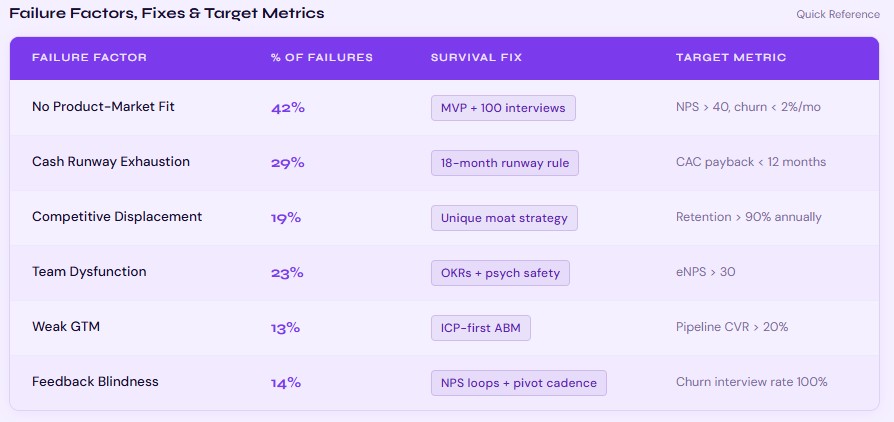
90% of SaaS startups fail within 10 years. The three leading causes are no product-market fit (42%), cash runway exhaustion (29%), and team dysfunction (23%). Founders who validate their MVP early, build a focused go-to-market strategy, and maintain at least 18 months of runway significantly outperform this baseline.
SaaS Failure Rate Statistics for 2026

Why are rates climbing in 2026? AI hype generated over 50,000 new SaaS launches in 2025 alone — but only 10% reached $1M ARR, according to the Failory 2026 Report. Increased market saturation means undifferentiated products are punished faster than ever.
Benchmark: Only 1 in 10 SaaS startups crosses the $1M ARR milestone. Of those, roughly 40% reach $10M ARR within five years (SaaStr, 2025).
Product-market fit (PMF) is the single largest predictor of SaaS failure. Founders build before validating demand, resulting in a technically sound product with no willing buyers.
Signs you lack PMF:
2024 example: Brex's enterprise expansion burned through $500M building tools SMBs did not need or ask for, forcing a painful product retraction.
Burn rate exceeding revenue growth is fatal when venture capital dries up. In 2025–2026, VC deal volume dropped 18% year-over-year (Crunchbase, 2025), leaving startups without a funding safety net.
Rule of thumb: Maintain a minimum of 18 months of runway at all times. If you have less than 12 months, fundraise or cut costs immediately.
Recent case: Inflection AI raised $1.5B but was unable to control operational costs during its 2025 pivot, resulting in a forced acquisition.
Vague targeting and weak messaging produce zero traction, even for products with genuine value. Without an Ideal Customer Profile (ICP) and channel strategy, CAC balloons and conversion rates collapse.
2025 example: Ramp competitor Capture ran broad digital ads instead of owning a niche, failing to compete against Ramp's focused messaging and sales motion.
Co-founder conflicts, misaligned executive incentives, and psychological safety failures destroy momentum. Team problems are the most underreported cause of failure because founders rarely publicize internal dysfunction.
Warning signs: Recurring missed OKRs, high early-employee churn, co-founder disagreements on company direction.
Established players like Salesforce, HubSpot, and Microsoft can outspend, out-market, and out-integrate new entrants. AI-native competitors lowered the build barrier in 2024–2026, accelerating commoditization.
Example: Jasper AI clones flooded the market from 2024 to 2026, with most drowning as ChatGPT and Claude became commodity infrastructure.
Ignoring user signals leads to product drift and retention collapse. Startups that do not build systematic feedback loops — NPS surveys, churn interviews, usage analytics — iterate in the wrong direction.
Example: Several Notion competitors, including Capacities, were slow to act on UX feedback, ceding ground to iterative, customer-obsessed players.

These strategies are associated with the 10% of SaaS startups that survive and scale:
Run a minimum of 100 discovery interviews before building. Use pre-sell tactics (landing pages, letters of intent) to confirm willingness to pay. Snowflake validated enterprise demand extensively before its IPO.
Define your Ideal Customer Profile with firmographic, technographic, and behavioral attributes. Use account-based marketing (ABM) to target precisely. Broad outreach is expensive; narrow outreach compounds.
Bootstrap to $1M ARR where possible. Reduce burn by prioritizing revenue-generating activities over vanity metrics. Treat every dollar as if the next funding round does not exist.
Weekly OKR reviews, documented decision frameworks, and psychological safety practices reduce the odds of co-founder conflict. Bring in an experienced operator (COO or VP of Ops) before you feel you need one.
In a saturated AI SaaS market, moats come from: proprietary data, deep workflow integrations, network effects, or service-wrapped software. HubSpot's freemium model created a distribution moat that took competitors a decade to understand.
Run monthly NPS surveys, quarterly churn win/loss interviews, and weekly product usage reviews. Make customer feedback a company-wide ritual, not a product team afterthought.
Ready to audit your GTM strategy and growth model? Contact Purple Path for a tailored SaaS growth review.
What percentage of SaaS startups fail?
Approximately 90% of SaaS startups fail within 10 years. Year-one failure rates are around 10%, rising to 70% by year five.
What is the number one reason SaaS startups fail?
No product-market fit accounts for 42% of SaaS failures, making it the single largest cause. Founders build without validating genuine demand.
How long does the average SaaS startup survive?
Most SaaS startups that fail do so between years three and five. The critical danger window is when initial runway expires before the company reaches sustainable unit economics.
What ARR do most SaaS startups reach?
Only 10% of SaaS startups reach $1M ARR. Of those, roughly 40% go on to reach $10M ARR within five years.
How can a SaaS startup avoid running out of cash?
Maintain at least 18 months of runway, reduce burn by focusing spend on revenue-generating activities, and begin fundraising conversations at least 6 months before you need capital.
What is product-market fit in SaaS?
Product-market fit means a meaningful segment of customers finds your product indispensable, evidenced by low churn (under 2% monthly), high NPS (above 40), and organic word-of-mouth growth.
Is the SaaS market saturated in 2026?
Yes. Over 50,000 new SaaS products launched in 2025 alone. Only startups with a clear differentiation moat — proprietary data, deep integrations, or network effects — are successfully competing.