.png)
How to Build a Go-to-Market Strategy from Scratch: A 2026 Guide for B2B SaaS
For B2B SaaS leaders in 2026, the old go-to-market playbooks feel increasingly disconnected from reality. You’ve built an exceptional product, but the path to predictable revenue is obscured by stalled sales pipelines, inconsistent messaging between markets, and the daunting cost of hiring full-time executives. The traditional model of GTM—a static document delivered by a large, detached consulting firm—is no longer sufficient.
Modern go-to-market strategy consulting is not a one-time launch plan; it is a dynamic, execution-heavy partnership. It's about embedding seasoned expertise into your team to connect your product to the right market, drive demand, and build a revenue engine that scales. This guide provides the exact steps to build that engine from scratch, leveraging the power of fractional leadership to achieve your goals in competitive markets like Western Europe and the US East Coast.
Key Takeaways
- GTM Has Evolved: In 2026, a Go-to-Market (GTM) strategy is a continuous, iterative process, not a one-off launch plan. It must adapt to self-serve buyer journeys and demand generation-led growth.
- Fractional is the Advantage: For most B2B SaaS companies, a Fractional CMO offers a faster, more cost-effective, and execution-focused alternative to expensive big-firm consultants or premature full-time executive hires.
- Data Over Intuition: Building a successful GTM strategy requires a rigorous, data-driven approach to defining your Ideal Customer Profile (ICP), crafting messaging, and selecting the right demand channels.
- Localization is Non-Negotiable: A "one-size-fits-all" GTM strategy will fail. Success in markets like Western Europe and the US East Coast demands a nuanced understanding of cultural, regulatory (GDPR), and competitive differences.
Table of Contents
- What is Go-to-Market Strategy Consulting in 2026?
- How to Build a Go-to-Market Strategy from Scratch
- The Fractional Advantage: GTM Strategy Consulting vs. Full-Time Hires
- Localising Your GTM: Navigating Western Europe and US East Coast Markets
- Executing Your Path: How purple path Partners for Scale
- Frequently Asked Questions
What is Go-to-Market Strategy Consulting in 2026?
Go-to-Market (GTM) strategy consulting is a collaborative partnership designed to build a scalable, repeatable engine that connects your product’s value to market demand, turning product-market fit into predictable revenue. In the crowded B2B SaaS landscape of 2026, it’s no longer about a single product launch. It’s about creating a continuous GTM motion that adapts to evolving buyer behaviour and market dynamics.
The core symptoms of a broken GTM strategy are painfully familiar to many founders: a high Customer Acquisition Cost (CAC), low sales win rates, a long sales cycle, and a pipeline that feels perpetually stuck. These aren't isolated problems; they are signs that the fundamental bridge between your product and your market is flawed.
According to Go-to-market strategy, this is a well-documented area of ongoing research and practical application.
The Evolution of GTM for B2B SaaS
Buyer journeys have fundamentally shifted. Prospects now prefer self-serve discovery and peer validation over traditional sales-led demos. This change demands a move away from interruptive marketing toward demand generation-led GTM strategies that attract, educate, and capture high-intent buyers. In this context, GTM strategy consulting serves as the bridge between product readiness and successful market penetration.
Why Your Current Sales Pipeline Might Be Stalled
Friction points in the B2B sales cycle are often hidden. They can stem from misaligned messaging, targeting the wrong customer profile, or using ineffective channels. A stalled pipeline is a direct result of this friction. To uncover these hidden leaks, a systematic approach is needed. The first step is often a comprehensive audit to diagnose the root causes before prescribing a solution.
Read more: Learn how to find and fix hidden revenue leaks with our guide on conducting a 90-Day GTM Audit.
How to Build a Go-to-Market Strategy from Scratch
Building a robust GTM framework requires a structured, data-backed process that aligns your product, marketing, and sales teams around a single objective. Founder intuition is a powerful starting point, but scalable growth is built on a foundation of market reality. A Fractional CMO is uniquely positioned to facilitate this process, bringing an objective, expert perspective to guide your internal team through these critical steps.
Step 1: Defining Your Ideal Customer Profile (ICP)
A weak ICP is the primary reason most GTM strategies fail. It’s not enough to know basic demographics. You must go deeper into firmographics (company size, industry, revenue) and psychographic triggers (pains, motivations, buying behaviour). Use intent data to identify accounts actively researching solutions like yours and narrow your focus to win a specific, high-value market segment before expanding.
Research published by how to create a go-to-market strategy shows that this is a well-documented area of ongoing research and practical application.
Step 2: Crafting a GTM Messaging Framework
Your messaging must translate product features into tangible business outcomes for your ICP. C-suite buyers don’t purchase features; they purchase solutions to their most pressing problems. Develop a clear value proposition that answers the question: "Why should we choose you, and why now?" This core message must be consistently communicated across your website, sales decks, ad copy, and all other digital touchpoints to build brand coherence and trust.
Step 3: Selecting Your Demand Generation Channels
Early-stage SaaS companies often spread themselves too thin trying to be everywhere at once. The key is to identify and master one or two core channels before diversifying. For high-ticket B2B sales, a targeted Account-Based Marketing (ABM) strategy often outperforms broad inbound efforts. Analyze where your ICP congregates, what content they consume, and how your competitors are reaching them. Choose your channels based on that data, not on industry trends.
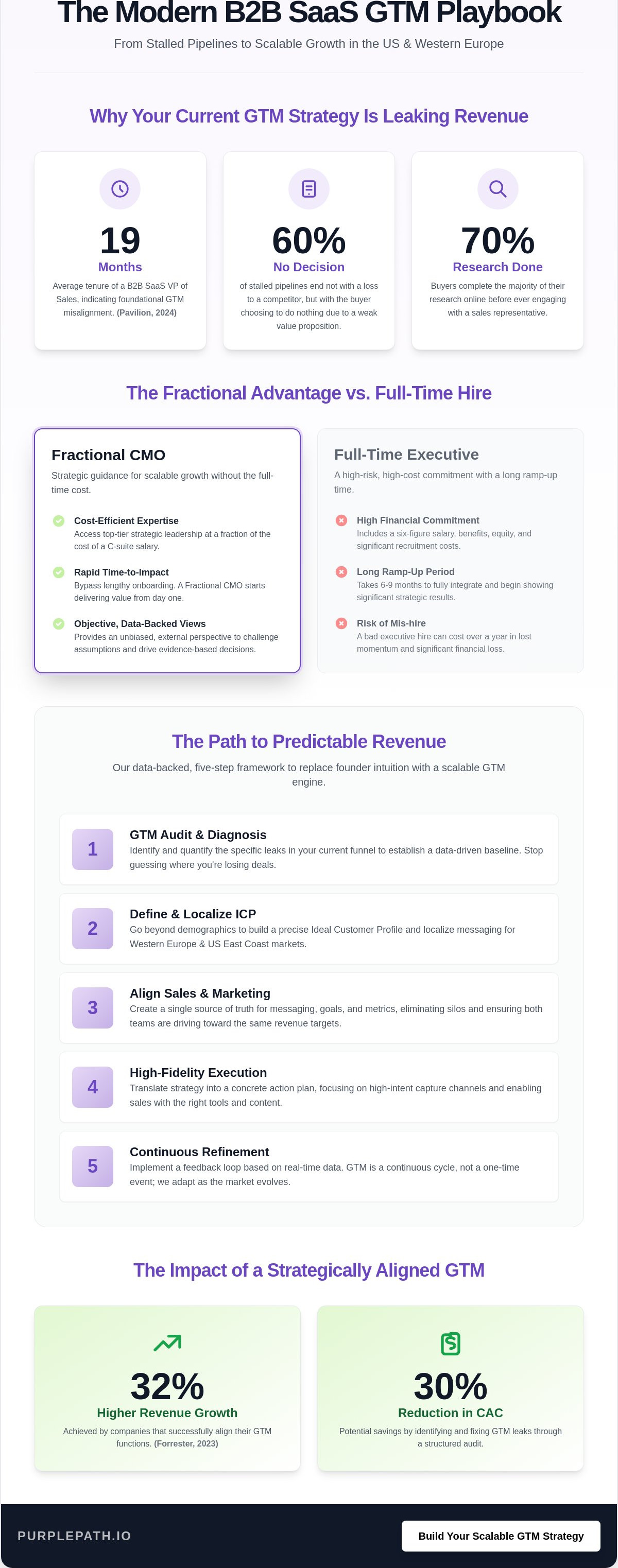
The Fractional Advantage: GTM Strategy Experts vs. Full-Time Hires
The most common objection to seeking expert help is the perceived cost. Founders often feel trapped between two undesirable options: hiring a full-time CMO too early—a significant financial risk—or engaging a traditional consulting firm that delivers theory but no execution. The Fractional CMO model provides a third, more effective path.
This model offers on-demand leadership from a seasoned executive who can build the strategy and roll up their sleeves to help your team implement it. For Seed and Series A startups, the cost-benefit is clear: you get C-level strategic guidance and hands-on execution at a fraction of the cost and commitment of a full-time hire.
Why Big Consulting Firms Often Fail SaaS Startups
Large consulting firms are structured to serve enterprise clients. Their deliverables are often theoretical slide decks filled with high-level frameworks that lack practical, "boots on the ground" application for a lean SaaS team. They come with high overhead and a lack of accountability for results. In contrast, a fractional partner like purple path operates as an extension of your team, focused on executing and driving measurable outcomes.
The ROI of Fractional GTM Leadership
The return on investment from a fractional leader extends beyond cost savings. They bring a wealth of cross-industry knowledge from scaling multiple companies, allowing them to identify patterns and avoid common pitfalls. This model is inherently flexible, enabling you to scale leadership up or down based on performance and business needs. A fractional partner provides the strategic firepower to build your GTM engine and the operational expertise to ensure it runs smoothly.
Explore our approach: See the specific areas where our fractional leaders execute by visiting the purple path services page.
Localising Your GTM: Navigating Western Europe and US East Coast Markets
A critical failure point for many SaaS companies is applying a single GTM strategy across different regions. The cultural, regulatory, and business landscapes of London, Dublin, and New York are vastly different. A "one size fits all" approach ignores these nuances and is destined to underperform.
For any company entering the EU, strict GDPR compliance is not just a legal requirement but a critical element of building trust with buyers. Furthermore, sales velocity expectations must be adjusted; European buyers often have a more consensus-driven, deliberate decision-making process compared to their US counterparts.
Winning the Western European Market
Key tech hubs like London, Berlin, and Dublin each have their own market dynamics. Success requires localized content that resonates culturally and, in some cases, multilingual demand generation campaigns. You must also navigate local business regulations, including VAT and specific contractual requirements, to ensure smooth B2B transactions.
Bridging the Gap to the US East Coast
The US East Coast, particularly hubs like New York and Boston, is characterized by a highly aggressive competitive landscape. To stand out, you need high-fidelity sales enablement materials and a rapid, persistent follow-up process. For teams operating remotely, effective time-zone management and clear communication protocols are essential for maintaining momentum and closing deals.
Executing Your Path: How purple path Partners for Scale
The journey from a stalled pipeline to a scalable revenue engine begins with a clear diagnosis and ends with disciplined execution. At purple path, we act as a seasoned guide on that journey. We partner with B2B SaaS leadership to move beyond theory and build a GTM strategy grounded in data, followed by the collaborative creation of a sales playbook that your team can actually use.
From Strategy to Execution: The 90-Day Roadmap
The first three months of a partnership with purple path are focused on building momentum and delivering tangible results. We begin with a deep audit, move to strategy and messaging development, and quickly launch initial demand generation campaigns. This work is underpinned by a focus on RevOps and marketing operations to ensure the foundational systems are in place for long-term scale. Our commitment is human-to-human; we embed ourselves in your team to drive success together.
Ready to Fix Your Pipeline?
Stop guessing and start building a GTM framework that delivers predictable results. If you're ready to move from uncertainty to a clear, data-driven path to growth, let's have a conversation.
Book a GTM strategy session with purple path
Frequently Asked Questions
What exactly does a Fractional GTM Strategy do for a B2B SaaS?
A fractional GTM strategy marketer helps a B2B SaaS company define its target market, craft its messaging, select the right sales and marketing channels, and set pricing. For purple path, this is not just theoretical; we act as fractional leaders who help execute the plan, build the demand engine, and align sales and marketing teams to drive revenue.
How much does Fractional GTM strategy typically cost?
Costs vary widely. Large, traditional consulting firms can charge six-figure fees for a strategy project. Full-time executive hires come with a significant salary and equity burden. A fractional marketing model, like the one offered by purple path, provides executive-level expertise and execution at a more manageable and flexible monthly retainer, making it ideal for startups and scale-ups.
How long does it take to see results from a new GTM strategy?
While foundational results like improved messaging can have an immediate impact, meaningful pipeline growth takes time. You should expect to see positive leading indicators (e.g., higher quality leads, increased website engagement) within the first 90 days. Significant, predictable revenue impact typically builds over 6-12 months as the GTM engine matures.
What is the difference between a GTM strategy and a marketing plan?
A GTM strategy is the high-level playbook that defines who you are selling to, what you are selling, where you will sell it, and how you will win. A marketing plan is a tactical component of the GTM strategy, detailing the specific campaigns, channels, content, and activities that will be used to execute the "where" and "how."
Does my startup need a Fractional CMO or a full-time hire?
For most early-stage (Seed to Series A) startups, a Fractional CMO is the more strategic choice. It allows you to access top-tier strategic talent and execution experience without the high cost, risk, and long-term commitment of a full-time executive hire before you have a proven, scalable GTM motion.
How do I measure the success of my GTM strategy?
Success is measured through a combination of key performance indicators (KPIs), including pipeline velocity, Customer Acquisition Cost (CAC), Lifetime Value (LTV), sales cycle length, and win rates. It's also measured by the alignment and efficiency of your sales and marketing teams.
Can purple path help with international market expansion?
Yes. A core area of our expertise is helping B2B SaaS companies navigate the complexities of international expansion, particularly between North American and European markets. We provide the strategic guidance needed to localize your GTM strategy for different cultural and regulatory environments.
What are the most common GTM mistakes for SaaS companies in 2026?
The most common mistakes include having a poorly defined Ideal Customer Profile (ICP), inconsistent messaging across channels, trying to scale too many marketing channels at once, misaligning sales and marketing teams, and ignoring the unique nuances of different geographical markets.