Embedded Fractional Marketing Teams vs. Full-Time Staff: The Strategic Choice for B2B Tech
The standard playbook for B2B Tech companies is broken. You raise a round, you write a job description for a unicorn VP of Marketing, and you spend six months interviewing candidates who talk a great game about brand equity but haven't touched an ad manager or a CRM in five years. By the time you hire them, your runway has evaporated, and your growth has stalled. You're left with a high-salaried leader who needs another $200,000 in headcount just to execute the basics.
The alternative is often a traditional agency, where you're assigned a junior account manager who treats your account like a ticket in a queue. Neither of these models fits the speed of modern SaaS. Enter the embedded Fractional Marketing team. It isn't just a middle ground; it's a fundamental shift in how senior-level marketing is bought and sold. For companies that need high-level strategy and immediate execution, the choice between full-time staff and a fractional model is the difference between scaling and stagnating.
TL;DR: Hiring full-time staff offers dedicated focus but carries massive overhead, long ramp-up times, and the risk of a generalist ceiling. An embedded Fractional Marketing team provides senior-level leadership and specialized execution at a fraction of the cost, letting B2B Tech companies scale faster without the long-term liability of a bloated payroll.
What is an Embedded Fractional Marketing Team?
To understand the value, we have to define what we're actually talking about. A Fractional Marketing team isn't a freelancer you found on a marketplace, and it isn't a traditional agency that stays at arm's length either. At purple path, we define an embedded team as a group of senior specialists who integrate directly into your company's workflow, communication channels, and culture. purple path's own comparison of strategic advisory against Fractional CMO engagements breaks down exactly where each model earns its fee.
They don't just deliver a PDF of recommendations and wish you luck. They own the KPIs. They sit in your Slack, they join your leadership meetings, and they operate as your internal marketing department. The fractional part refers to the cost and the time commitment: you're getting a slice of a CRO, a slice of a demand gen expert, and a slice of a content strategist, rather than paying $250,000-plus a year for one person who tries, and fails, to do all three.
This model is particularly potent for Tech companies in the Seed to Series B stages. At these phases, you don't need a full-time CMO to manage a team that doesn't exist yet. You need someone who can build the engine while driving the car. An embedded team provides the blueprint and the mechanics simultaneously.
The Myth of the Full-Time Unicorn
Founders often fall into the trap of looking for a single hire who can do it all: strategy, SEO, PPC, product marketing, and sales enablement. This person doesn't exist. If they do, they're likely running their own company or charging $400,000 a year at a Tier 1 Tech firm. When you hire a full-time marketing manager or director, you're usually getting one of two things: a strategist who can't execute, or an executor who can't think strategically.
When you hire a full-time employee (FTE), you aren't just paying their salary. You're paying for benefits, payroll taxes, equity, office equipment, and the overhead of having another direct report. Estimates from salary-data sources like Glassdoor and Payscale put the fully burdened cost of a senior marketing leader in a major Tech hub at $300,000 or more. For that same investment, an embedded Fractional Marketing team can provide three or four specialists who cover the entire marketing spectrum with much higher proficiency.
The Generalist Ceiling
The biggest risk of the FTE model is the generalist ceiling. A full-time hire might be great at Google Ads, but they're likely mediocre at technical SEO or high-level brand positioning. Because they're your only marketing resource, your company's growth is capped by their specific skill set. An embedded team removes this ceiling. If you need a heavy push on LinkedIn Ads this month, the team pivots. If you need a deep dive into your CRO (Conversion Rate Optimization) strategy next month, the resources are already there.
Why Fractional Marketing Matters: The Economic Reality
In the current venture climate, efficiency is the only metric that matters. The days of growth-at-all-costs spending are over. VCs are looking for companies that can prove a repeatable, scalable customer acquisition model without burning through their entire cash reserve. Fractional Marketing is the ultimate efficiency play.
- Speed to Market: A full-time hire takes 3 to 6 months to find and another 3 months to ramp up. An embedded team like purple path can start producing results in weeks.
- Flexibility: In SaaS, your needs change every quarter. A fractional model lets you scale your marketing spend and effort up or down without the trauma of layoffs or the friction of hiring.
- Access to Seniority: You get the judgment of a CRO who has scaled multiple companies, something a bootstrapped or early-stage Tech company could never afford on a full-time basis.
Marketing itself has changed too. As Seth Godin puts it:
“Marketing is no longer about the stuff that you make, but about the stories you tell.”
In the B2B Tech world, those stories need to be backed by data and technical precision. An embedded team brings that level of sophistication from day one.
Comparing the Models: A Strategic Breakdown
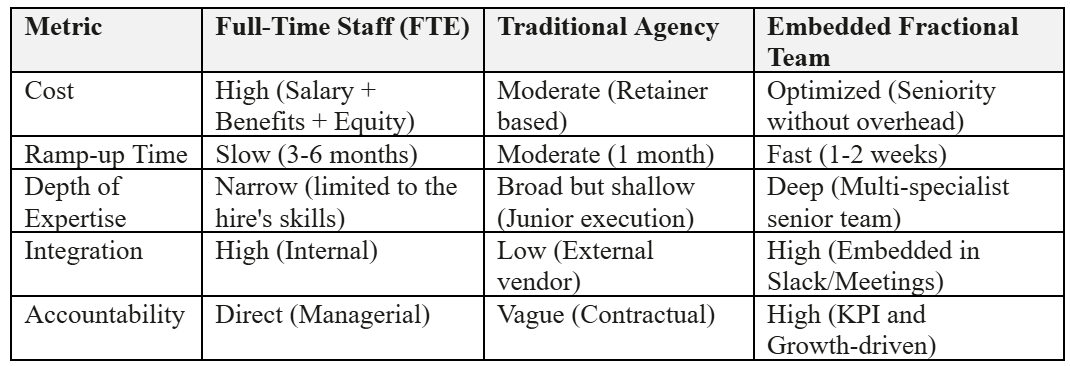
Choosing between an FTE, a traditional agency, and an embedded fractional team requires a look at the long-term impact on your business. Below is a comparison of how these models typically perform across key business metrics.
The Execution Gap: Why Strategy Isn't Enough
The most common complaint about Fractional Marketing, and consulting in general, is that it's all talk and no action. Many fractional CMOs hand over a beautiful slide deck and then leave the founder to figure out how to actually implement it. This is where the purple path model differs. We believe that strategy without execution is just a hallucination. purple path's own assessment of whether fractional marketers actually deliver takes this exact skepticism seriously rather than waving it away.
An embedded team closes the execution gap by taking over the doing. This includes setting up the HubSpot workflows, writing the ad copy, managing the webinars, and optimizing the landing pages. For a CRO or CEO, this means you aren't just getting advice; you're getting a functional department. This lets the leadership team focus on product development and high-level sales while the marketing engine runs in the background.
How to Transition to a Fractional Model
If you're currently struggling with a hiring freeze or a marketing department that isn't producing ROI, transitioning to an embedded team is a structured process. It isn't about firing everyone and starting over; it's about augmenting your current capabilities with senior-level precision. purple path's own Fractional CMO checklist walks through this exact process in more detail.
Step 1: Audit the Current Bottlenecks
Identify where your growth is stalling. Is it lead generation? A low conversion rate on your website? A lack of brand awareness in a crowded market? An embedded team starts by diagnosing the actual problem rather than just selling you a pre-packaged solution.
Step 2: Define the North Star Metric
Unlike a full-time hire who might get bogged down in internal politics, a fractional team is laser-focused on a specific outcome. Whether it's increasing MQLs (Marketing Qualified Leads) by 40% or reducing CAC (Customer Acquisition Cost), the engagement should be built around a clear, measurable goal.
Step 3: Integrate the Communication Stack
For an embedded team to work, they have to be treated as part of the company. This means access to Slack, Jira, Notion, or whatever tools your team uses. The goal is to eliminate the vendor feel. If you have to send an email to ask for a status update, the model is broken. You should be able to see the work happening in real time.
Step 4: Set a Cadence for Review
Senior leadership should meet with the fractional team weekly or bi-weekly to review data and pivot strategy. This makes sure the marketing efforts stay aligned with the broader business objectives, something that often gets lost with traditional agencies.
The Long-Term Play: Build, Measure, Transfer
One of the unique aspects of the purple path approach is that we don't aim to be a permanent fixture if your goal is to eventually build an in-house team. A great embedded team builds the systems, documents the processes, and eventually helps you hire the right full-time staff to take over the engine they've built. This build-measure-transfer model makes sure you aren't left with a marketing black box that only an outside agency understands.
By the time you're ready to hire a full-time CMO, you aren't asking them to build from scratch. You're handing them a high-performing machine with a proven track record. This makes your company much more attractive to top-tier talent, since they can focus on scaling rather than troubleshooting.
The Shift in B2B Marketing
The rise of Fractional Marketing mirrors the fractionalization of the entire C-suite. We now see fractional CFOs, fractional COOs, and even fractional CTOs. This is a response to the increasing specialization required to run a Tech company. It's no longer possible for one person to stay at the cutting edge of every discipline.
Marketing budgets are under more scrutiny than ever, with boards pushing for demonstrable efficiency over headcount for its own sake. The embedded fractional model fits that requirement by eliminating the underutilized capacity of full-time staff and the overhead of traditional agency management fees.
Conclusion: The Smart Path Forward
Hiring is a massive risk. In the B2B Tech world, a bad senior hire can set you back twelve months and hundreds of thousands of dollars. An embedded Fractional Marketing team mitigates that risk while providing a level of expertise usually reserved for the enterprise level. It lets you be nimble, data-driven, and efficient with your capital.
If you're tired of the hiring treadmill and ready for a marketing partner that actually acts like an owner, it's time to look at the fractional model. Stop looking for a unicorn and start building an engine.
Key Takeaways
- Efficiency over Headcount: Fractional teams provide senior-level strategy without the $300k-plus price tag of a full-time executive.
- Immediate Impact: Embedded teams ramp up in days, not months, filling the execution gap immediately.
- Specialization: You gain access to a diverse team of specialists (CRO, Demand Gen, Content) rather than relying on one generalist's limited skill set.
- Scalability: The model is designed to grow with you, offering the flexibility to scale up or down based on your funding and growth stages.
- Ownership: Unlike agencies, embedded teams sit in your Slack and own your KPIs, functioning as an internal department.
Frequently Asked Questions
How does a fractional team stay aligned with our company culture?
By being embedded. This means participating in your internal communications, attending relevant meetings, and understanding your product as deeply as any full-time employee. At purple path, we don't view ourselves as outsiders; we're part of your growth team.
Isn't it more expensive in the long run than a full-time hire?
Actually, no. When you factor in the fully burdened cost of an FTE (benefits, taxes, equity, office space, recruitment fees), a fractional team is almost always more cost-effective. The ROI is typically higher too, since you're paying for senior-level output from day one.
What happens if we want to hire a full-time CMO later?
That's a success story. A good fractional team will have built the systems and processes that make your company attractive to a top-tier CMO. We can even help you vet candidates and manage the transition so no momentum is lost.
Can a fractional team handle our specific Tech niche?
B2B Tech and SaaS have unique challenges like long sales cycles and complex buyer committees. An embedded fractional team that specializes in these sectors, like purple path, brings a library of proven playbooks built specifically for your business model. purple path's own Fractional CMO selection guide covers what to look for in that specialization.
How much time do I need to spend managing a fractional team?
Ideally, less than you'd spend managing a junior or mid-level FTE. Because the team is senior-led, they need high-level strategic alignment rather than day-to-day hand-holding. They're there to take work off your plate, not add to it.
Book a Consultation
If you're a B2B Tech founder or leader looking for senior-level marketing execution without the full-time overhead, let's talk. purple path provides the strategy and the boots on the ground to turn your marketing into a predictable growth engine.